
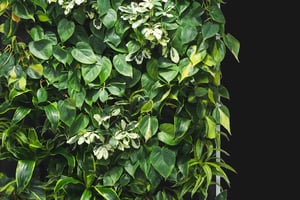
Plants have been a staple of indoor spaces for centuries, long appreciated for bringing visual warmth and calm into indoor spaces. Yet when it comes to actually cleaning the air in modern, airtight buildings, passive potted plants hit a hard physical limit.
In this guide, we examine the scientific evidence behind botanical biofiltration, comparing traditional passive houseplants with engineered active green walls that use mechanical airflow, soil-free root zones, and microbial ecosystems to continuously remove gaseous pollutants and fine particulate matter from indoor air.
1. The NASA clean air study & the passive houseplant debate
The modern interest in plant-based air purification began with NASA's research into biological life-support systems for closed space habitats. In sealed laboratory chambers, researchers demonstrated that common foliage plants and their root systems could reduce concentrations of volatile organic compounds (VOCs) such as benzene, formaldehyde, and trichloroethylene over 24-hour periods.
However, translating sealed-chamber experiments into real-world offices and homes exposed a critical bottleneck: air diffusion.
In a typical room with standard mechanical ventilation, air moves around a potted plant rather than through its root zone. A comprehensive meta-analysis evaluating reported VOC removal efficiencies of passive potted plants standardized 196 experimental results into Clean Air Delivery Rates (CADR) and found that a single passive plant provides a median CADR of just 0.023 m³/h. Achieving the same pollutant removal rate as a standard building ventilation system would require placing 10 to 1,000 potted plants per square meter of floor space.
Rather than discrediting plants, this finding pinpointed the exact engineering requirement needed to unlock their potential: active airflow. By mechanically drawing contaminated indoor air directly through the plant's root zone, active botanical biofilters overcome diffusion limits and multiply pollutant removal rates by orders of magnitude.
2. How active botanical biofiltration works
Unlike decorative living walls that rely on passive air contact and traditional potting soil, an active botanical biofilter is engineered as a living air-purification reactor. Research on botanical biofiltration of indoor gaseous pollutants shows that purification relies on a three-part biological and physical synergy:
- Mechanical airflow & adsorption: Built-in fans pull polluted room air through a porous, inorganic growth substrate (often incorporating granular activated carbon or expanded clay). The substrate immediately adsorbs airborne VOCs from the airstream, trapping them inside the moist root zone.
- Rhizosphere microbial biodegradation: The true metabolic engine of a biofilter is not the leaves, but the microbial communities living around the plant roots (rhizosphere). Studies examining microbial and chemical dynamics in active green wall systems confirm that root-zone bacteria rapidly adapt to airborne pollutants, breaking down trapped VOCs into harmless carbon dioxide, water, and microbial biomass.
- Plant-microbe symbiosis: While microbes perform the biochemical degradation, the plants sustain the ecosystem. Plant roots continuously oxygenate the growth medium, regulate moisture, and exude sugars and amino acids that feed pollutant-degrading bacteria—preventing the filter media from saturating over time, as shown in analyses of bacterial community shifts in indoor biofilters.
3. Measured performance: VOCs, particulates & humidity
Peer-reviewed chamber and field evaluations demonstrate that active green walls remove multiple categories of indoor air pollutants simultaneously while improving thermal comfort:
- Gaseous VOC Removal: Controlled experiments on air flux and temperature influences in indoor biofiltration show high single-pass removal efficiencies for aromatic hydrocarbons such as toluene, ethylbenzene, and xylene (BTEX compounds), with performance scaling predictably with airflow rates and substrate moisture.
- Particulate Matter (PM) Capture: Active green walls also function as physical and electrostatic traps for airborne dust and fine aerosols. Field assessments of botanical biofiltration against traffic and indoor air pollution demonstrate significant reductions in fine particulate matter and nitrogen dioxide alongside gaseous VOCs.
- Natural Bio-Humidification: As air passes through the moist root substrate and plant canopy, natural evapotranspiration adds clean, molecular water vapor to dry indoor air. Reviews of practical indoor air phytoremediation systems highlight that maintaining indoor relative humidity within the optimal 30–60% window reduces mucosal irritation, eye dryness, and airborne viral stability without the risk of ultrasonic misting droplets.
4. Active biofiltration vs. conventional air purification
Building managers often evaluate active green walls alongside conventional mechanical HEPA and activated carbon air purifiers. While both technologies reduce indoor pollutants, they operate through fundamentally different mechanisms:
| Feature | Passive Potted Plants | Conventional HEPA + Carbon Purifiers | Active Botanical Biofilters (Green Walls) |
| Airflow mechanism | Passive diffusion only | Mechanical fan forced airflow | Mechanical fan airflow through root zone |
| Gaseous VOC removal | Negligible in real rooms | High initially, but carbon saturates and requires replacement | Continuous biological regeneration by root microbes |
| Particulate capture | Minimal leaf surface settling | Very high ($\text{PM}_{2.5}$ and ultrafine particles) | Moderate to high via moist substrate and foliage |
| Indoor humidity impact | Minimal | None (can worsen perceived dryness) | Natural bio-humidification into optimal 30–60% range |
| Biophilic & well-being benefits | Visual greenery only | None | Combines air purification with restorative nature contact |
5. Designing & integrating active green walls
State-of-the-art reviews on phytoremediation for the indoor environment emphasize that maximizing real-world performance requires matching system design to building conditions:
- Soil-Free, Automated Substrates: Replacing traditional potting soil with engineered inorganic media prevents mold spore proliferation, eliminates soil gnats, and ensures uniform airflow resistance across the entire wall.
- Smart Sensor Integration: Automated irrigation, nutrient dosing, and fan-speed modulation keep root-zone moisture at the exact threshold needed for both healthy plant transpiration and peak microbial VOC degradation.
- Strategic Placement: Positioning active green walls in high-occupancy zones—such as open-plan offices, meeting rooms, classrooms, and healthcare waiting areas—delivers purified, humidified air directly into the human breathing zone while simultaneously providing acoustic absorption and biophilic stress relief.
Naava air purifying green walls
Contact us to start improving your indoor air quality. Naava green walls are scientifically backed, biological air purifiers with convenient design.
Scientific references & further readingCummings, B. E., & Waring, M. S. (2019). Potted plants do not improve indoor air quality: A review and analysis of reported VOC removal efficiencies. Journal of Exposure Science & Environmental Epidemiology, 30(2), 253–261. https://doi.org/10.1038/s41370-019-0175-9 Darlington, A. B., Dat, J. F., & Dixon, M. A. (2000). The biofiltration of indoor air: Air flux and temperature influences the removal of toluene, ethylbenzene, and xylene. Environmental Science & Technology, 35(1), 240–246. https://doi.org/10.1021/es0010507 Matheson, S., Fleck, R., Irga, P. J., & Torpy, F. R. (2023). Phytoremediation for the indoor environment: A state-of-the-art review. Reviews in Environmental Science and Bio/Technology, 22, 249–280. https://doi.org/10.1007/s11157-023-09644-5 Mikkonen, A., Li, T., Vesala, M., Saarenheimo, J., Ahonen, V., Kärenlampi, S., Blande, J. D., Tiirola, M., & Tervahauta, A. (2018). Biofiltration of airborne VOCs with green wall systems—Microbial and chemical dynamics. Indoor Air, 28(5), 697–707. https://doi.org/10.1111/ina.12473 Pettit, T., Irga, P. J., & Torpy, F. R. (2018). Towards practical indoor air phytoremediation: A review. Chemosphere, 208, 960–974. https://doi.org/10.1016/j.chemosphere.2018.06.048 Pettit, T., Torpy, F. R., Surawski, N. C., Fleck, R., & Irga, P. J. (2021). Effective reduction of roadside air pollution with botanical biofiltration. Journal of Hazardous Materials, 414, 125566. https://doi.org/10.1016/j.jhazmat.2021.125566 Russell, J. A., Hu, Y., Chau, L., Pauliushchyk, M., Anastopoulos, I., Anandan, S., & Waring, M. S. (2014). Indoor-biofilter growth and exposure to airborne chemicals drive similar changes in plant root bacterial communities. Applied and Environmental Microbiology, 80(16), 4805–4813. https://doi.org/10.1128/aem.00595-14 Soreanu, G., Dixon, M., & Darlington, A. (2013). Botanical biofiltration of indoor gaseous pollutants – A mini-review. Chemical Engineering Journal, 229, 585–594. https://doi.org/10.1016/j.cej.2013.06.074 |