

We spend up to 90% of our lives indoors, yet the air inside our homes, offices, and schools is often significantly more polluted than the air outside. Over the past several decades, modern building techniques have prioritized energy efficiency and airtightness. While this conserves energy, it frequently traps a cocktail of chemical pollutants, moisture, and microbial particles indoors.
In this comprehensive guide, we review the scientific consensus across key research studies examining what causes poor indoor air quality (IAQ), how office equipment and building materials off-gas, and how indoor air pollution directly impacts human health, cardiovascular function, cognitive performance, and workplace productivity.
1. The Evolution of indoor pollutants & chemical exposure
Indoor air quality has changed dramatically over the last half-century. Historical analyses tracing changes in indoor pollutants since the 1950s show a massive shift in the types of synthetic materials, adhesives, flame retardants, and electronics present in our living and working environments.

We eat about 1 kg of food a day and drink about 2 liters of water a day, but we breathe more than 10 000 liters of air every day.
Volatile organic compounds (VOCs) & chemical sensitivity
Volatile Organic Compounds (VOCs) are carbon-based chemicals that easily evaporate into the air at room temperature. Common sources include:
-
Paints, varnishes, and sealants
-
Synthetic carpets, pressed wood furniture, and plastics
-
Cleaning chemicals, air fresheners, and scented candles
Studies evaluating indoor VOCs and chemical sensitivity reactions show that elevated exposure to indoor chemicals triggers a range of physiological responses, including mucosal irritation, headaches, skin reactions, and respiratory discomfort. Furthermore, broad epidemiological data confirms a strong association between personal VOC exposure and adult asthma.
Physiological & brain wave responses to VOCs
Beyond respiratory symptoms, scientific research demonstrates that VOC exposure impacts cardiovascular indicators and brain wave activity:
- Neurological impact: Electroencephalogram (EEG) readings reveal abnormal brain wave activity when exposed to indoor formaldehyde concentrations as low as 0,05 mg/m3 with subjects exhibiting heightened mental fatigue during cognitive tasks.
- Cardiovascular stress: Elevated indoor concentrations of VOCs correlate with decreased Heart Rate Variability (HRV) and autonomic dysfunction, particularly in older adults and sensitive individuals.
2. Quantifying the health risks: Air pollution vs. smoking
To make the health risks of poor air quality tangible, researchers established a framework comparing health risks of air pollution expressed as equivalent numbers of passively smoked cigarettes.
Key Findings on Health Equivalents:
-
An increase of 10 µg/m³ in fine particulate matter and 1 µg/m³ in nitrogen dioxide corresponds to the health harm of smoking 2.5 to 5.5 passive cigarettes per day.
-
Living or working near major traffic corridors in urban centers introduces health risks equivalent to passively smoking up to 10 cigarettes daily.
-
Primary endpoints affected include reduced lung capacity, low birth weight in newborns, cardiovascular mortality, and elevated cancer risk detailed in reviews on the human health effects of air pollution.
In addition to physical health, large-scale Scandinavian population data demonstrates an association between air pollution and psychiatric disorders in children and adolescents, underscoring the deep connection between air purity and mental health.
3. Sick building syndrome (SBS), dampness & ventilation
When buildings suffer from inadequate ventilation, high humidity, or chemical off-gassing, occupants frequently experience Sick Building Syndrome (SBS), a medical condition where building occupants suffer acute health or comfort effects tied directly to time spent in a specific building.
Chemicals, moisture, and mold in dwellings
Research investigating building-related symptoms in newly built dwellings reveals that:
- VOC Mixtures: Even at low individual concentrations, total combined VOC levels (including toluene, xylene, and ethylbenzene) significantly increase the odds of throat and respiratory symptoms by 2.4 times.
- Dampness & mold: Condensation on window panes and visible mold growth increase the likelihood of general SBS symptoms by up to 4.4 times. Moisture creates ideal breeding grounds for airborne microbial propagules.
- School & office dust toxicity: Cross-sectional research shows that building-related symptoms link to the in vitro toxicity of indoor dust and airborne microbial propagules.
The critical role of ventilation rates (CO2 and humidity)
Proper ventilation is the first line of defense against indoor air stagnation. Meta-analyses evaluating ventilation rates and carbon dioxide concentrations in commercial buildings show that:
- Higher outdoor air supply rates: Dramatically reduce occupant complaints and lower the risk of sick leave associated with outdoor air supply rates
- Relative humidity management: Maintaining relative humidity between 30% and 60% prevents the indirect health effects of relative humidity in indoor environments, avoiding viral persistence, dust mite proliferation, and mucosal drying.
- Carbon dioxide accumulation: Inadequate fresh air intake causes CO2 levels to spike, directly impairing mental clarity as proven in controlled studies on cognitive function scores under ventilation and VOC exposures.
4. Economic & productivity impacts of poor air quality
Poor indoor air quality isn't just a health concern; it carries a massive economic burden through lost worker productivity and increased absenteeism.
| IAQ Factor | Measured Impact on Human Performance |
| High VOCs & Computer Emissions | Decreases typing speed, accuracy, and office output |
| Short-Term Ambient Pollution | Substantially lowers standardized cognitive scores |
| Perceived Poor Air Quality | Increases self-reported workplace productivity loss |
| Optimized IAQ & Ventilation Rates | Yields billions in nationwide productivity gains |
- Office equipment off-gassing: Emissions from personal computers and electronics negatively affect perceived air quality, causing SBS symptoms and directly reducing daily office output.
- Short-term exposure spikes: Research on short-term air pollution exposure and cognitive performance proves that pollution spikes diminish logical reasoning and human capital productivity.
- Perceived air quality losses: Studies evaluating perceived indoor air quality and productivity loss demonstrate that uncomfortable, polluted air directly reduces employee focus and efficiency.
- Nationwide economic gains: Macroeconomic models published in the Indoor Air Quality Handbook estimate that optimizing indoor environmental quality nationwide yields tens of billions of dollars annually in reduced healthcare costs and increased workforce productivity.

Conclusion & Recommendations
The scientific evidence is unambiguous: indoor air pollution is a widespread, multi-faceted challenge driven by synthetic materials, trapped VOCs, high humidity, and low ventilation rates. Addressing these factors requires a multi-pronged approach:
-
Source control: Minimize synthetic fragrance products, choose low-VOC building materials, and maintain office electronics.
-
Ventilation: Maintain fresh air exchange rates to prevent CO2 and humidity buildup.
-
Air purification & biofiltration: Integrate advanced filtration and botanical biofiltration systems to continuously remove airborne particulates and gaseous pollutants.
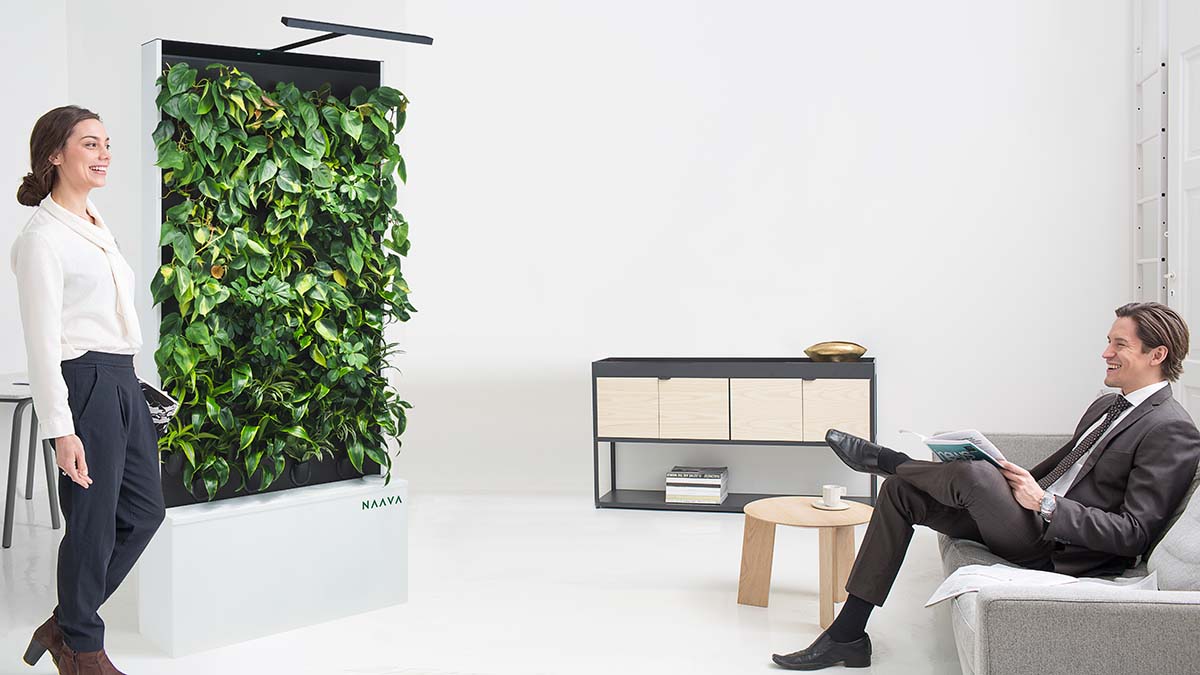
Naava green wall purifying and humidifying indoor air in an office environment.
Scientific references & further readingAllen, J. G., et al. (2016). Associations of cognitive function scores with carbon dioxide, ventilation, and VOC exposures in office workers. Environmental Health Perspectives, 124(6), 805–812. https://pubmed.ncbi.nlm.nih.gov/26502459/ Arif, A. A., & Shah, S. M. (2007). Association between personal exposure to volatile organic compounds and asthma among US adult population. International Archives of Occupational and Environmental Health, 80(8), 711–719. https://pubmed.ncbi.nlm.nih.gov/17357796/ Arundel, A. V., et al. (1986). Indirect health effects of relative humidity in indoor environments. Environmental Health Perspectives, 65, 351–361. https://pubmed.ncbi.nlm.nih.gov/3709462/ Bako-Biro, Z., et al. (2004). Effects of pollution from personal computers on perceived air quality, SBS symptoms and productivity in offices. Indoor Air, 14(3), 178–187. https://pubmed.ncbi.nlm.nih.gov/15104785/ Dantoft, T. M., et al. (2013). Indoor Volatile Organic Compounds and chemical sensitivity reactions. Journal of Environmental and Public Health, 2013, Article 623812. https://pubmed.ncbi.nlm.nih.gov/24228055/ Fan, X., Zhang, Y., & Li, B. (2022). Investigating cognitive workload and task performance under indoor air pollutants exposure using electroencephalogram. Journal of Building Engineering, 57, Article 104883. https://www.researchgate.net/publication/389105977_Investigating_cognitive_workload_and_task_performance_under_indoor_air_pollutants_exposure_using_electroencephalogram Fisk, W. J. (2000). Estimates of potential nationwide productivity and health benefits from better indoor environments: An update. Indoor Air Quality Handbook, McGraw-Hill, 4.1–4.36. https://www.academia.edu/2038575/Indoor_air_quality_handbook Kampa, M., & Castanas, E. (2008). Human health effects of air pollution. Environmental Pollution, 151(2), 362–367. https://www.sciencedirect.com/science/article/abs/pii/S0269749107002849 Lavy, V., Ebenstein, A., & Roth, S. (2014). The impact of short term exposure to ambient air pollution on cognitive performance and human capital formation (NBER Working Paper No. 20648). National Bureau of Economic Research. https://www.nber.org/papers/w20648 Milton, D. K., Glencross, P. M., & Walters, M. D. (2000). Risk of sick leave associated with outdoor air supply rate, humidification, and occupant complaints. Indoor Air, 10(4), 212–221. https://pubmed.ncbi.nlm.nih.gov/11089326/ Oudin, A., et al. (2016).Association between neighbourhood air pollution concentrations and dispensed medication for psychiatric disorders in a large longitudinal cohort of Swedish children and adolescents, BMJ Open, 6(6), Article e010004. https://bmjopen.bmj.com/content/6/6/e010004.abstract Saijo, Y., et al. (2004). Symptoms in relation to chemicals and dampness in newly built dwellings. International Archives of Occupational and Environmental Health, 77(7), 461–470. https://link.springer.com/article/10.1007/s00420-004-0535-0 Salonen, H., et al. (2016). Building-related symptoms are linked to the in vitro toxicity of indoor dust and airborne microbial propagules in schools: A cross-sectional study. Environmental Research, 151, 725–733. https://www.sciencedirect.com/science/article/abs/pii/S0013935116306090 Seppänen, O. A., Fisk, W. J., & Mendell, M. J. (1999). Association of ventilation rates and carbon dioxide concentrations with health and other responses in commercial and institutional buildings. Indoor Air, 9(4), 226–252. https://pubmed.ncbi.nlm.nih.gov/10649857/ Tang, H., Liu, W., & Shen, J. (2021). Effects of indoor VOCs from paint on human brain activities during working memory tasks: An electroencephalogram study. Building and Environment, 195, Article 107758. https://pubmed.ncbi.nlm.nih.gov/35904389/ Vardoulakis, S., et al. (2016). Air pollution in perspective: Health risks expressed in equivalent numbers of passively smoked cigarettes. Environmental Research, 148, 200–208. https://www.sciencedirect.com/science/article/pii/S0013935116301268 Wargocki, P., et al. (1999). Perceived air quality, Sick Building Syndrome (SBS) symptoms and productivity in an office with two different pollution loads. Indoor Air, 9(3), 165–179. https://www.researchgate.net/publication/223580938_The_effect_of_perceived_indoor_air_quality_on_productivity_loss Weschler, C. J. (2009). Changes in indoor pollutants since the 1950s. Atmospheric Environment, 43(1), 153–169. https://www.researchgate.net/publication/259913238_Changes_in_Indoor_Pollutants_Since_the_1950s Ye, D., Boursi, B., & Zhang, Y. (2021). Exposure to volatile organic compounds and vascular/autonomic function: Heart rate variability and arterial stiffness outcomes. Environmental Health Perspectives, 129(5), Article 057008. https://pmc.ncbi.nlm.nih.gov/articles/PMC13279124/ |